
Irwin Release Dates Explained
A projected date is an estimate based on the sentence, credit already applied, and the rules of the agency holding the person. It is not proof that a person left custody. The actual release date is the date the agency records the person as discharged, released to the community, or transferred. Those outcomes are not the same. Someone who leaves the Irwin County Detention Center for the Georgia Department of Corrections, another county, federal custody, or ICE is no longer in the local jail but is still in custody.
Pretrial custody follows a different path. A person awaiting trial has not received a term from which officials can compute a sentence-completion date. Bond may be posted, a judge may change conditions, a charge may be dismissed, or another hold may prevent departure. The court file and the jail's custody/release status are therefore the sound sources. For a sentenced person, ask which date is being quoted and which agency calculated it.
Find an Irwin Release Date
Begin with the custody type, not a broad name search. The Irwin County Sheriff's Office handles local jail records. GDC handles state-prison records. The State Board of Pardons and Paroles handles tentative parole timing and parole decisions, while the Department of Community Supervision manages people after release to felony supervision. Each channel answers a different question.
- Confirm the holding system. Ask the Irwin County jail for custody/release status if the person was held locally. A missing name does not prove release.
- Get the sentence order. For a county sentence, obtain the order or docket from the proper court. It establishes the term, credit for time served, and any later change.
- Search state records when needed. Use the GDC offender query for a person who entered state custody. Include inactive offenders when checking a past release.
- Read the date label. Separate MRD from TPM, parole eligibility, and a final parole release date. Similar-looking dates carry different meanings.
- Confirm near the date. Ask the jail, GDC, or the Parole Board whether a hold, order, or review changed the expected outcome.
The broader Irwin County released inmate search explains how to trace a person after the custody event. For a projected date, stay with the agency that presently controls the sentence.
Georgia State Release Date Terms
Georgia state records use specific terms. The GDC terminology page defines Maximum Release Date, or MRD, as the date the judge's sentence will be completely served. It is also called max-out. A Tentative Parole Month, or TPM, is the month in which the Parole Board expects to complete final review and, when appropriate, set a parole release date. A TPM is not the release date.
Most parole-eligible state inmates become eligible for consideration after serving one-third of the sentence, according to the Georgia parole process. Eligibility is not a promise. The Board may grant, deny, defer, reconsider, or attach conditions. Serious violent felonies, mandatory minimum terms, life sentences, and non-parole-eligible offenses can alter or bar ordinary parole timing. Georgia does not have one universal 85-percent rule for every state prisoner.
- MRD or max-out
- The point at which the judge's full sentence is served, subject to the lawful calculation in the record.
- TPM
- A tentative month for final parole review, not a confirmed departure date.
- Parole
- Release from prison before max-out under conditions set through the state parole process.
- Discharge
- The formal end of the relevant custody or supervision term.
What Changes Irwin Release Timing
A date can move even when the original sentence remains the same. State credits require eligibility and continued satisfactory conduct. Parole review is discretionary. A court can enter a new order, and another agency can lodge a hold. The key is to identify the authority behind the change.
| Factor | Possible effect | Best source |
|---|---|---|
| Performance Incentive Credit | May reduce an eligible state offender's TPM or MRD | GDC record and PIC guidance |
| Program progress or conduct | Can affect credit or a parole precondition | GDC and Parole Board |
| Parole decision | May grant, deny, defer, or change tentative timing | State Board of Pardons and Paroles |
| Court order or corrected sentence | Can alter the controlling term or credit | Sentencing court and custody agency |
| Detainer or transfer | May end local custody without release to the community | Jail plus the receiving agency |
| Time-served calculation | Changes the remaining county sentence | Irwin jail and sentencing court |
Irwin County has a special reason to check holds. The sheriff's immigration reports document DHS detainers, and ICE lists the detention center address in its own facility material. A local release entry may thus record a transfer rather than a return to the community.
Georgia Credits and Irwin Dates
GDC's Performance Incentive Credit program rewards eligible state offenders for satisfactory progress in programs, work, and conduct. Eligible offenders may collect up to 12 points, with a possible one-to-twelve-month effect on TPM or MRD. That range is not automatic. GDC lists exclusions that include death sentences, terms of two years or less, life sentences, non-parole-eligible offenses, and certain mandatory-minimum categories.
O.C.G.A. 42-5-101 authorizes work incentive credits. Georgia administrative rules in Subject 125-3-7 allow GDC to report credits to the Parole Board and recommend that they advance a tentative parole release date. The Board still makes the final parole choice when parole is involved. O.C.G.A. 17-10-6.1 is also relevant because serious violent felony sentences carry restrictions that can displace ordinary parole assumptions.
Search GDC Irwin Release Records
The state query begins with a disclaimer. After accepting it, a name search supports partial first and last names, age and physical-description filters, and active, inactive, or combined scope. Released state offenders may be classified as inactive. Searching active records alone can hide the match. A known GDC ID is usually stronger than a broad name search; the form also provides a case-number mode.
The GDC find-an-offender guide says county jail cases belong with the county, so do not use a blank state result to decide that an Irwin detainee has no date. GDC also warns that public results may be incomplete and directs formal verification to Inmate Records and Information, PO Box 1529, Forsyth, GA 31029.
The official GDC query and its disclaimer can be reviewed at the state offender search.
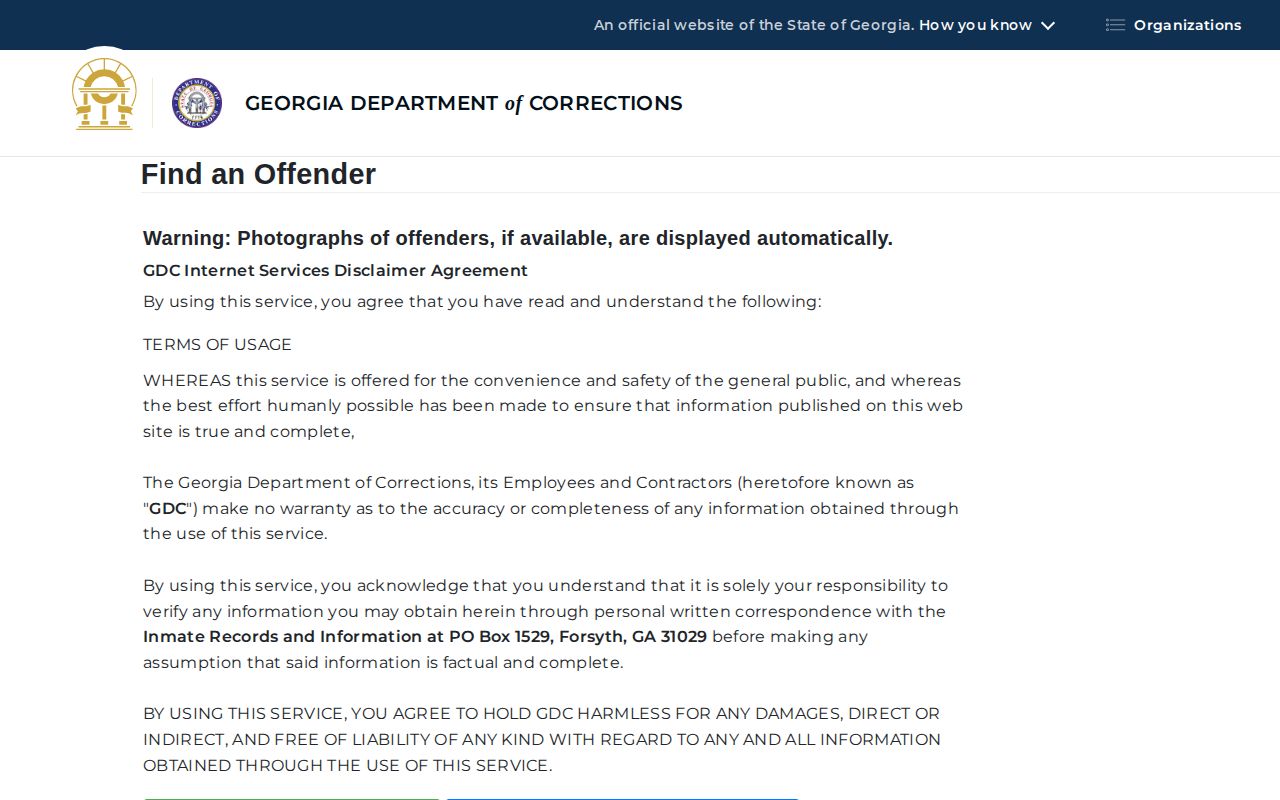
The screen is a state-prison lookup, not a live list of people held or released by the Irwin County jail.
Confirm an Irwin Release Date
For local custody, call the Irwin County Detention Center at (229) 468-4121 and ask for custody/release status plus the release record. Request the release date and time, release reason, and transfer destination if one applies. For written proof, Georgia's Open Records Act, O.C.G.A. 50-18-71, requires a response within three business days when records are available. If they are not ready, the response may instead state the expected time and cost. No local per-page fee was documented, so request an estimate before copies are made.
For a pending event, Georgia VINE can send a custody-change notice when the agency supplies the record. The VINELink release check explains the name or ID search and notification registration. VINE is not a permanent release archive, and an alert does not explain every court condition or transfer. Pair it with the agency record.
For state custody, compare the current GDC record with TPM information from the Parole Board. A person who has actually left prison may then appear in the parolee search or through DCS supervision. The Tifton DCS field office serves Irwin County, but a supervision record confirms community oversight, not the exact jail release calculation.
Federal BOP sentence dates and ICE custody use separate systems. Neither can substitute for an Irwin County release record or a Georgia state MRD. Following the custody chain prevents a projected date from being mistaken for an actual release.
Irwin Court Release Date Records
A short county sentence cannot be checked through one statewide corrections formula. The jail calculates its custody period from the controlling order and the credit it receives, while the court record supplies the legal basis. The Irwin County Superior and Juvenile Court clerk handles felony and other listed criminal records at 301 South Irwin Avenue, Suite 103, Ocilla. The clerk's number is (229) 468-5356, and the GSCCCA listing gives weekday hours from 8:00 a.m. to 5:00 p.m.
Match the record request to the court. Superior Court is the usual source for a felony sentence. Magistrate Court may hold first-appearance or warrant material. An Ocilla city matter may be with the municipal court clerk at 111 North Irwin Avenue rather than the county superior clerk. The Georgia Courts E-Access gateway may route a search to a provider and may require an account, so a blank portal result is not the end of the inquiry. Certified copies and older dockets may still require direct clerk contact.
Ask for the sentencing order, later amended orders, docket entries affecting bond or custody, and the final disposition. Then compare those papers with the jail calculation. A sentence end written in a court file can still differ from the day a person walks out if another hold exists. Conversely, a bond or dismissal may authorize release before any sentence date exists. The jail's actual release entry resolves the last step.
Irwin Parole Timing Is Separate
The State Board of Pardons and Paroles handles parole consideration and decisions. The Georgia Department of Community Supervision handles felony parole and probation supervision after release. For Irwin County, DCS lists the Tifton field office, not an office in Ocilla. That split means a DCS record can help confirm that a person is now under supervision, but DCS does not turn the earlier TPM into the actual prison release record.
Use the Board's TPM explanation and lookup while the person remains in state prison. After release on parole, use the parolee search and the DCS office as appropriate. Monthly public Board meetings are policy and operations meetings; they are not public person-by-person parole hearings. A meeting date therefore should never be substituted for a named inmate's release date.
Conditions can also matter before a tentative date becomes final. The Board may require good conduct, program completion, or another precondition. If those terms are not met, review can be delayed or the result can change. Confirm the latest state record shortly before the expected event and use VINE only as a custody-change alert, not as the sentence calculator.